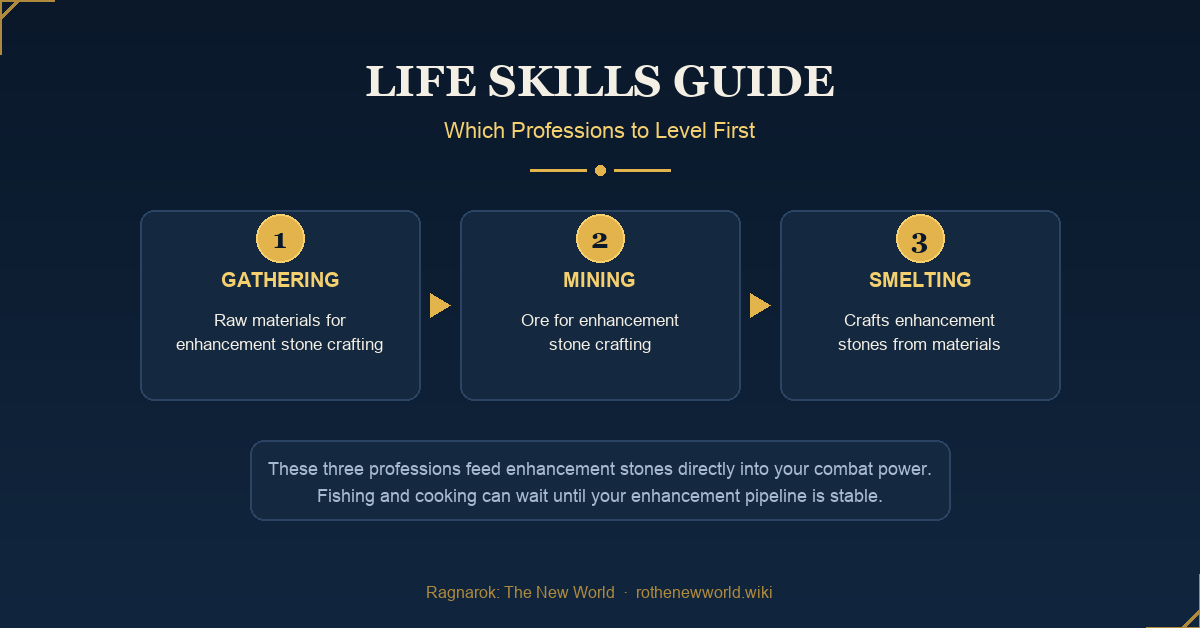
The life skill system in Ragnarok: The New World is not optional side content. It feeds directly into your combat power through enhancement stones. This guide covers which professions to level, which ones can wait, and how the vitality economy works for F2P players.
Key takeaways:
- Level gathering, mining, and smelting first. These three professions feed enhancement stones directly into your combat power. Each amplify threshold (+10, +25, +40) unlocks bonus stat lines on your gear. The material demand is high throughout the early and mid-game.
- Fishing and cooking can wait. They produce buff foods that sell, and personal use helps, but the return is lower than enhancement materials in the first two months. The database confirms 16 recipes across 6 towns, gated behind the Private Chef quest.
- Spend your daily vitality. Event vitality adds up. Skipping days widens the gap.
- Monthly card players get a vitality advantage. Two shop items (Western Herbal Tablets + Honey King) grant 560 extra vitality per day through Star Stones. The gap over two months is significant.
- Gold is the bottleneck. Every life skill level costs gold. Pick your three and commit.
The life skill system
All life skills are learnable. Each one costs gold to level up, and the gold cost is substantial.
The available professions:
| Profession | What do you get from it? | Priority |
|---|---|---|
| Gathering | Raw materials for enhancement stone crafting | High |
| Mining | Ore for enhancement stone crafting | High |
| Smelting | Crafts enhancement stones from gathered materials | High |
| Fishing | Food buff ingredients | Low (early game) |
| Cooking | Makes foods that is used for character buff. Can be for sale or personal use | Low (early game) |
How gathering, mining, and smelting translate to power
These three professions feed the enhancement system. Enhancement stones raise your gear’s amplify level. Each piece of gear has amplify thresholds that unlock bonus stat lines.
Here is what you get at each threshold, using a typical weapon as an example:
| Amplify Level | What Unlocks | Example Bonus (Shadow Weapon) |
|---|---|---|
| +10 | First bonus stat line | Ranged Magic DMG +2% |
| +25 | Second bonus stat line | MATK% +3% |
| +40 | Third bonus stat line | Ranged Magic DMG +5% |
These bonuses are not small. Stacked across your weapon, armor, cape, shoes, and accessories, the amplify system is one of the biggest sources of combat stats in the game. A player who neglects enhancement falls behind fast.
The material pipeline works like this:
- Gathering collects raw materials from the field.
- Mining collects ore nodes.
- Smelting combines gathered materials and ore into enhancement stones.
Without these three skills leveled, you rely on the market or event drops for enhancement materials. The demand is high and the supply from events alone is not enough. Early game basic stones get consumed quickly, and moving to the next equipment tier requires the ultimate weapon enhancement stones. Being self-sufficient means leveling all three.
The database confirms the full material ladder:
| Enhancement Material | Level Band | Source |
|---|---|---|
| Enhance Stone | Lv 1 to 20 | Elite/Mini event rewards |
| Weapon Enhanced Metal I | Weapons + Accessories 21 to 40 | Guild Shop Lv.1 100 Merit; Elite drops (12.5%) |
| Weapon Enhanced Metal II | 41 to 60 | Guild Shop 200 Merit |
| Weapon Enhanced Metal III | 61 to 80 | Guild Shop 400 Merit |
| Weapon Enhanced Metal IV | 80+ | Guild Shop 800 Merit |
| Armor Enhanced Spirit Stone I | Armor/Capes/Shoes 21 to 40 | Guild Shop 100 Merit; Elite drops (12.5%) |
| Armor Enhanced Spirit Stone II | 41 to 60 | Guild Shop 200 Merit |
| Armor Enhanced Spirit Stone III | 61 to 80 | Guild Shop 400 Merit |
| Armor Enhanced Spirit Stone IV | 80+ | Guild Shop 800 Merit |
Monsters drop only Metal I and Spirit Stone I. Normal monsters have a 0.007% drop rate. Elite variants (Ringleader, Swift, Solid, Furious, Elusive) drop them at 12.5%. Tiers II through IV have no monster source. Guild Shop Merit is the only path for those.
The recommended path: gathering, mining, smelting
Focusing on three professions for the first one to two months:
- Gathering. Collects raw materials.
- Mining. Collects ore.
- Smelting. Crafts the enhancement stones from gathered materials.
The reasoning: enhancement stone consumption is huge. The gold cost to level all five life skills is too high for F2P and low-spending players. Budgeting wisely means picking the three professions that feed your combat power directly.
Other life skills: fishing and cooking
Fishing and cooking are not useless. They are just lower priority than the enhancement trio. Here is what each one does.
Fishing
Fishing supplies ingredients for cooking. The game has fishing spots across multiple maps. You catch fish that serve as recipe materials for buff dishes.
Fishing does not produce enhancement materials. It does not raise your combat stats directly. Its entire value comes from feeding the cooking system, which is why it pairs with cooking and not as a standalone profession.
Cooking
Cooking starts with the Private Chef quest (unlocked in Prontera). After completing it, you can find cooking stations across six towns:
| Town | Recipe |
|---|---|
| Prontera | Grape Wine, Cherry Jelly, Blueback Soup |
| Izlude | Green Salad, STR Dish, Steamed Scorpion |
| Morroc | Supreme STR Dish, Purple Vadon Congee |
| Geffen | Magic Broth, VIT Dish |
| Alberta | Mana Chowder, Squid Tentacle Soup |
| Payon | Fried Sweet Potato, Apple Pudding, Red Fish Hotpot |
The dishes that name a stat directly (STR Dish, VIT Dish, Supreme STR Dish) suggest the buff system grants temporary stat bonuses. Mana Chowder likely restores or boosts max mana. Magic Broth likely boosts magic-related stats.
Cooked dishes can be sold for in-game currency. Players who want buff foods without leveling cooking themselves will buy from the market. If you want to earn in-game currency, cooking has a place. But the demand is limited compared to enhancement materials.
For everyone else, fishing and cooking are a later-game investment. Once your enhancement pipeline is stable and you have spare gold, you can loop back and level them.
The vitality system
The life skill system runs on vitality points. You get a daily allocation. You also earn vitality from events:
- Peers arena
- Challenge activities.
- Daily activity completions
Run your dailies every day. The vitality from events adds up, and skipping them widens the gap between you and consistent players.
The premium vitality gap (P2W)
There are two shop items that grant extra vitality every day:
- Western Herbal Tablet. Gives 460 vitality.
- Honey King. Gives 100 vitality.
Together, they add 560 vitality per day. These are purchasable with Star Stones, the premium diamond currency that monthly card players receive.
Let’s do the math: 560 extra vitality per day × 30 days = 16,800 extra vitality per month. Over two months, that is 33,600 more vitality than a free-to-play player. That gap translates directly into more enhancement stones and faster gear progression.
F2P and low-spending players: compare yourself to players with similar spending levels. Do not measure against monthly card players who get the extra vitality. Play at your own pace.
Gold: the hidden cost
Upgrading life skill levels costs gold. The gold consumption is high, and free-to-play players need to budget carefully. This is another reason to focus on three professions instead of spreading gold across all five.
Source:
Leave a Reply